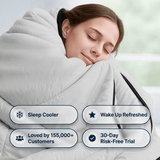


The Science Behind Temperature-Regulating Bedding
It's 2 AM. You're awake again. Not anxious, not thirsty. Just too warm. The sheets feel damp and suffocating and you've already kicked off the comforter twice. You'll probably blame the room temperature or stress.
There's a good chance the bedding itself is the problem.
What you sleep in and on has a direct impact on how your body handles temperature through the night. When that fabric fails you, your sleep does too.
The Science Behind Temperature-Regulating Bed Linen
Your body runs a temperature management system all night long.
To enter and hold deep sleep, your core temperature needs to drop by roughly one to two degrees Fahrenheit. That's the trigger. And bedding that holds heat against your skin instead of letting it escape gets in the way of that drop, interrupting sleep cycles in ways you won't register as individual wake-ups. You just feel unrested and can't explain why.
Fabrics that regulate temperature do two jobs well:
- Move air through the weave rather than blocking it
- Move moisture off the skin so evaporation can cool you
Here's the thing. It's not really about natural versus synthetic. It's about fibre structure. A fibre's shape, surface texture, and how it handles water decide whether heat leaves your body or sits on it.
The Magic of Fibre Structure
Bamboo fibres are naturally smooth, long, and fine. That structure is doing more work than most people realize.
Smooth fibres let moisture travel along and through the fabric instead of pooling in one spot. Fine fibres pack into a weave that still lets air move. And bamboo's natural moisture-wicking capacity is exactly what synthetic fabrics have to be chemically engineered to fake.
The Comfy Sleepers Bamboo Sheet Set is built on this. Breathable, temperature regulating, absorbs sweat and keeps you dry, and silky-soft enough for sensitive skin.
Not every fabric handles every temperature the same way, though. The right pick depends on whether you sleep warm, sleep cold, or swing between the two.
Bamboo Bedding
Bamboo is the strongest performer here, and it's not close.
The fibres wick moisture noticeably faster than cotton, which matters more than it sounds. Sweat that moves off your skin quickly evaporates quickly. Sweat that sits there just makes you damp and cold. Bamboo also holds a cooler-to-touch surface feel, so the sheet doesn't warm up under you the way heavier fabrics do.
What that gets you:
- Cool in summer, cozy in winter - the same breathability works both directions
- Silky, weightless feel - smoother and finer than high-thread-count cotton
- Naturally hypoallergenic - resistant to dust mites and bacteria, good for eczema or sensitive skin
- Softer with every wash - most fabrics degrade, bamboo improves
- Wrinkle and fade resistant - it holds up
- Machine washable - cold, gentle cycle, no fuss
Honestly, that last one gets underrated. A fabric you're scared to wash isn't a fabric you'll actually use.
Cotton Bedding
Cotton's what most American households already sleep in, and there are good reasons for that. Familiar, everywhere, and when it's made well it performs consistently.
Cotton fibres absorb a lot of moisture relative to their weight, pulling sweat off the skin and spreading it across the fabric where it evaporates. The result is a drier sleep surface than you'd get from a heat-trapping alternative.
But absorbing and transporting aren't the same thing. Cotton soaks moisture up and holds it. Bamboo moves it along and off. That's the difference between waking up in a damp sheet and waking up in a dry one, and it's why hot sleepers who've done everything right with cotton still find it warm by morning.
If cotton's been almost working for you, bamboo is the direct upgrade.
Navigating Night Sweats, Hormones and Sleep
Night sweats hit differently from general overheating. It's not just a warm room.
Hormonal fluctuations, whether from menopause, perimenopause, pregnancy, or general variation, affect the hypothalamus - the part of the brain running your temperature control. When it misfires, your body dumps heat through the skin all at once. You wake up soaked, then cold, then uncomfortable no matter what the thermostat reads.
Bedding can't stop hormonal night sweats. Nothing in your linen closet will.
But it can change how disruptive they are. A fabric that pulls moisture away immediately and lets it evaporate fast means you're not lying in a wet sheet for the next hour, and that removes a real layer of the misery. Bamboo is the strongest option here, on both moisture transport speed and that naturally cool surface.
Exploring Our Temperature-Regulating Bedding Fabrics
Different constructions suit different sleepers. Here's the rundown.
Bamboo: The All-Season Choice
Bamboo's fibre structure gives it genuine year-round range. It works for warm sleepers and cool sleepers both. It softens with every wash. And it handles moisture better than anything else across a full night.
Which Fabric is Right for Your Temperature?
| Sleep style | Best fabric options |
|---|---|
| Sleeps warm all year | Bamboo |
| Sleeps cold | Brushed cotton, bamboo |
| Temperature swings night to night | Bamboo |
| Hormonal night sweats | Bamboo |
| Sensitive skin | Bamboo, organic cotton |
| All-season versatility | Bamboo |
Notice the pattern? Yeah. That's not us being cute, it's just what the fibre structure does.
What You Get in the Set
The Bamboo Sheet Set runs $79.99 USD and comes in ten colors, from Silver Chill to Midnight Indigo.
Sizes: Twin, Full, Queen, King
Twin: 1 flat sheet, 1 fitted sheet, 1 pillowcase
Full, Queen, King: 1 flat sheet, 1 fitted sheet, 2 pillowcases
Returns: 30-day money-back guarantee
The Secret to Better Sleep
The bedroom temperature advice everyone gives is fine. Keep it between 60 and 67 degrees Fahrenheit for most adults.
But the thermostat only controls the ambient air. Your bedding controls the microclimate around your actual body, and those are two different numbers. A room at 65°F under heat-trapping sheets will feel warmer than a room at 68°F under breathable bamboo.
That's where the fabric decision matters. Choosing for how your body actually runs at night is the change most people haven't made, and it's usually the one that lands fastest.
Start there. Not with a sleep tracker.