

The Search for the Best Cooling Blanket When Nobody Actually Sleeps
I asked three people what to do about waking up at 3 am stuck to the mattress like a damp sticky note. My mom said open a window, which in a heatwave does nothing but let the mosquitoes in. A guy at the coffee shop told me to quit dairy. My friend with no kids and too much money told me to buy a refrigerated mattress pad that needs its own plumbing and costs more than my car.
None of that helped at 3 am with a sweat-soaked shirt peeled to my chest. When you sleep hot, or share a bed with someone going through night sweats, the hunt for the best cooling blanket turns from a casual search into a full-blown midnight obsession.
So here's what I actually learned.
The Absolute Witchcraft of Thermal Regulation
Before this, I figured all blankets were basically the same, differing only in how much they made your bed look like a catalog photo. Turns out there's a whole category of textiles engineered specifically to stop you marinating in your own sweat.
From my highly imperfect, half-asleep reading of textile guides at 4 am, it comes down to two approaches: active and passive cooling.
The space-age synthetic stuff. These are the active cooling blankets, made from nylon, spandex, and engineered fibers that genuinely feel cold to the touch, like the cool side of the pillow. They pull your body heat away and send it off into the ether.
The nature-did-it-first stuff. This is passive cooling: linen, specific cotton weaves, and viscose from bamboo or eucalyptus. They don't feel icy, but they breathe so well the heat escapes before your bed turns into a swamp.
I tried a cooling weighted blanket once. Felt like being gently crushed by a chilly ghost. We don't talk about that.
The One Thing the Doctor Was Firm About
Quick serious note in the middle of the sweat saga, because it matters. When you've got a baby in the house, and you discover fabrics that actively cool, the tempting thought is to wrap the little one in them too.
Don't. Every pediatric guideline is blunt about this: no loose blankets in a crib for a baby under twelve months, no matter how magical the fabric, because of the suffocation risk. The advice is to keep the room comfortable (roughly 68 to 72°F) and dress them in a breathable sleep sack instead. So the fancy adult cooling blankets stay on the grownups' bed, where they belong. Once kids are past the toddler line and safe with loose fabric, breathable layers are fair game.
That's the one non-negotiable in this whole story. Everything else is preference.
Fabrics That Actually Do Something Other Than Suffocate You
If you're hunting for the best cooling blanket for your own sanity, the material is everything. You can't grab a thin polyester fleece and hope, because polyester is basically wearable plastic. It's the exact thing making you sweat.
Here's the shortlist that actually delivers:
- Engineered cooling synthetics (nylon/spandex blends): feel cold on contact, best for people who want that instant chill
- Bamboo viscose: silky, breathable, and brilliant at soaking up moisture so you're not waking up damp
- Linen: breathes aggressively, ages well, though it's textured and wrinkles instantly
- Loosely woven cotton: familiar and breathable, as long as it's not packed into a dense weave
The standout for a lot of hot sleepers, especially anyone dealing with night sweats, is a proper engineered cooling fabric or a good bamboo. Both let heat leave instead of trapping it against you. That's the whole game.
The Absolute Audacity of the Laundry Instructions
Here's what nobody warns you about the high-tech, icy-to-the-touch blankets: they're divas in the wash.
I learned this the expensive way. Bought a highly-rated nylon-blend cooling comforter. Glorious for three nights. Then a stomach bug happened, as they do, right in the middle of the bed at 4 am. And at 4 am you are not reading care labels. You're shoving everything in on the hottest cycle and praying.
Do not do this. Do not boil a synthetic cooling blanket and then blast it in the dryer on surface-of-the-sun. I melted the cooling finish. It went in feeling like a frozen lake and came out like a crunchy, staticky piece of astroturf, cooling powers gone for good. Because heat destroys the very thing that makes it work.
Which is half the reason we drifted back toward natural fibers. Bamboo, linen, and cotton don't demand a thermodynamics degree to clean. Wash cool, skip the fabric softener (it coats the fibers and kills the wicking), air dry when you can. Forgiving, in a way the synthetics absolutely are not.
When You Just Need Everything to Stop Being So Damp
Some seasons of life are just wet. Between the heat, the sweat, the spills, and whatever else, staying dry starts to feel like a luxury for people who get eight uninterrupted hours.
You don't need a blanket with an engineering manual. You just need to stop wrapping yourself in cheap microfleece that traps heat like a greenhouse. A genuinely breathable layer won't fix your sleep on its own, but it might mean that when you do get woken up, you're not completely fused to the mattress.
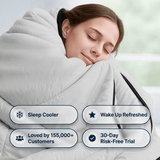
If you want the engineered-cooling route, our Ice Cooling Calming Blanket is built for exactly this. It uses breathable, moisture-wicking fibers that feel cool to the touch and let body heat pass through instead of trapping it, and so it's gentle on sensitive skin. It comes in four sizes and several colors, washes on a cold gentle cycle (learn from my astroturf incident), and includes a 30-night trial. Good alone in summer, or layered under a quilt when it cools off.
Unqualified Answers to Your Midnight Panic Searches
Do cooling blankets really work, or is it just marketing?
They work, in two different ways. The synthetics feel genuinely cold and pull heat off you; the naturals like bamboo and linen just let heat escape instead of trapping it. If you sleep hot, ditching your standard polyester duvet is half the battle right there.
Can my baby use a cooling blanket?
Not under twelve months. No loose blankets in the crib, full stop, because of the suffocation risk. Dress them in a breathable sleep sack and keep the room cool instead. Once they're a toddler and safe with loose fabric, breathable bamboo is great.
What's the worst fabric for night sweats?
Polyester, microfiber, fleece. Anything that's basically spun plastic. However soft it feels in the store, wrapping up in microfiber during night sweats is like wearing a trash bag in a sauna. It traps the moisture right against you.
How do I wash a cooling blanket without ruining it?
Respect the care label. Cool wash, no fabric softener, and for the love of sleep, keep the synthetic ones out of a hot dryer. Air drying is safest and usually quick anyway.
The honest bottom line? There's no single miracle blanket. But get the fabric right and wash it properly, and you go from fused-to-the-mattress to actually, occasionally, sleeping. Which, when nobody in the house sleeps, feels like a genuine miracle.