

Best Cooling Blanket for Menopause and Hot Flashes
Every menopause sleeper knows the routine. You kick the covers off mid-flash, cool down, get too cold, pull them back, and repeat until sunrise. The blanket is supposed to be the comfortable part of the bed. During menopause, it becomes the thing you fight all night.
The fix isn't sleeping without one. It's choosing a blanket that works with your body instead of against it.
This guide covers what the fabric actually needs to do, why most blankets fail at it, and how to pick the right one.
Why Blankets Are the Hardest Part of Menopause Sleep
Hot flashes and night sweats trace back to shifting estrogen affecting the hypothalamus, the part of the brain that manages body temperature. Your internal thermostat loses its fine-tuning, reads a small rise in core temperature as an emergency, and responds with a heat dump. Blood rushes to the skin, sweating kicks in, and you wake up overheated and damp.
Here's where the blanket makes it worse. A conventional blanket is insulation. Its whole job is holding heat in. During a hot flash, that turns a short episode into a drawn-out one by trapping the heat and humidity your body is trying to shed.
So you throw it off, which works until the sweat evaporates and you get chilled, and then you're awake again pulling it back. Every swing in that cycle drags you out of deep sleep. You can't control the hormones, but the blanket is a variable you absolutely can.
What to Look for in a Blanket for Hot Flashes
Moisture-Wicking Fabric
Non-negotiable. Cotton absorbs sweat and holds it against your skin, and a damp blanket becomes a clammy one that keeps you awake long after the flash has passed. Wicking fabric moves moisture away from the body so it can evaporate, and that evaporation is what cools you in the first place. It's the difference between waking in wet bedding and sleeping through the recovery.
Breathability
A blanket that traps warm, humid air builds a little greenhouse around you. Breathable construction lets heat escape continuously instead of piling up hour after hour. That matters between flashes as much as during them, since a lower baseline temperature under the covers gives your body less reason to hit the panic button.
Cool-to-the-Touch That Lasts
Plenty of fabrics feel cool for thirty seconds, then warm to body temperature. What you want is a surface that keeps drawing heat away. That sustained cool feel matters most in the minutes after a flash, since it's the signal that tells your body the bed is safe to settle back into, shortening the gap between waking and falling asleep again.
Weight and Layerability
Heavy blankets and dense fills hold heat. That's physics. For hot flashes, lighter is smarter. A lightweight cooling blanket can be your only top layer in summer or the base under a light comforter in winter, so you adjust with the seasons without giving up the heat and moisture management underneath.
Are Weighted Blankets Good for Hot Flashes?
Usually not. The dense fill that gives a weighted blanket its pressure is also excellent at trapping heat, which is the opposite of what a hot flash needs. Most turn a warm sleeper into a hot one within minutes.
Choose one with breathable construction and put moisture-wicking layers between it and your skin. For most people managing frequent night sweats, though, a light, breathable cooling blanket is the better call.
How Blanket Materials Compare for Menopause
Every material has a different profile across the things that matter for hot flashes.
| Material | Moisture-Wicking | Breathability | Cool-to-Touch | Best for |
|---|---|---|---|---|
| Advanced cooling fabric | Excellent | Excellent | Yes, sustained | Menopause, hot flashes, night sweats |
| Cotton | Absorbs, doesn't wick | Moderate | No | Mild sleepers, light sweating |
| Fleece / microfiber | Poor | Poor | No | Cold climates, not hot flashes |
| Down / alternative | Poor | Low | No | Cold sleepers, insulated by design |
| Bamboo / viscose | Moderate | Moderate | Somewhat | Warm sleepers, inconsistent for heavy sweat |
| Standard weighted | Poor | Poor | No | Pressure seekers, traps heat |
The pattern's clear. Traditional materials are built to insulate, and insulation is exactly the problem during menopause.
The Best Cooling Blanket for Menopause Sleepers
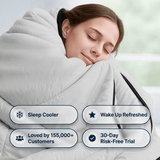
If you're buying one blanket to address menopause sleep disruption, look for the combination above in a single fabric. Our Ice Cooling Blanket is built around exactly those principles.
Its Advanced Cooling fabric is engineered to absorb surplus surface heat on contact and keep drawing it away, so it stays cool through the night instead of warming up in the first ten minutes. Its Q-max of 0.42, the cool-to-the-touch score, is woven into the fiber, not sprayed on, so it doesn't wash out.
What makes it work for hot flashes specifically is the balance. It's light enough that heat escapes during an episode, and comfortable enough that you're not sleeping uncovered to compensate. That's the whole point: you stop choosing between too hot and too cold.
- Moisture-wicking to move sweat off your skin so it evaporates
- Breathable so warm, humid air escapes instead of building up
- Sustained cool touch rather than a first-touch trick
- Lightweight as a summer top layer or a winter base layer
And since hot flashes don't check the clock, it works draped over the couch during the day just as well as on the bed at night.
A Blanket Is One Layer of the System
A cooling blanket does real work, but it's the top layer. If the sheets underneath are soaked cotton, you're still sleeping on the problem. Breathable, moisture-wicking sheets handle the contact layer, so every layer manages heat together.
Room temperature matters too. Most guidance points to a sleep environment in the mid-to-upper 60s Fahrenheit. Between the bedding and the thermostat, you've got more control over menopause sleep than it feels like at 3am.
Finding the Best Cooling Blanket for Menopause
The best cooling blanket for menopause isn't the one with the coldest first touch. It's the one still working at 3am, after the second hot flash, when a regular blanket would be soaked and radiating heat back at you.
That means moisture-wicking fabric, breathable construction, and a cool-to-the-touch surface that lasts. A cooling blanket can't stop hot flashes, and nothing on your bed can.
FAQs
What is the best cooling blanket for menopause?
One that's moisture-wicking, breathable, and cool to the touch, so it manages heat instead of trapping it. Look for a fabric that draws surface heat away on contact and a breathable construction that lets warm, humid air escape rather than build up.
Do cooling blankets work for menopause?
They don't treat menopause or stop hot flashes, which are hormonal at the root. What they can do is cut the heat and moisture buildup that makes each episode harder to sleep through, which may shorten recovery time and ease the covers-off-then-freeze cycle. The blanket manages the sleep surface, not the underlying cause.
Are weighted blankets good for hot flashes?
Most aren't. The dense fill traps heat against the body, working against what a menopause sleeper needs. If you rely on the pressure, choose a breathable build and pair it with moisture-wicking layers underneath.
What blanket material is best for night sweats?
A moisture-wicking performance fabric. Cotton holds sweat, fleece and microfiber trap heat, and down insulates by design. A fabric engineered to move moisture and stay cool keeps the surface drier through the night.