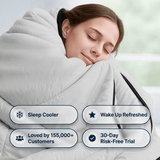



Cooling Blanket for Shift Workers and Daytime Sleeping
Most sleep advice assumes everyone sleeps at night.
For the millions of Americans working night shifts, rotating schedules, or early morning starts, that assumption doesn't hold. Nurses, paramedics, firefighters, factory workers, pilots, and countless others need to sleep during the day. And daytime sleeping, particularly in warmer months, is a fundamentally different challenge.
The room is brighter. The house is noisier. And the temperature is almost always higher than it would be at midnight. For shift workers trying to get quality rest during the afternoon, managing warmth isn't a comfort preference. It's a practical necessity.
Why Daytime Sleep Is Harder for the Body
The difficulty isn't just environmental. There's a physiological reason daytime sleep is harder to achieve and maintain.
The body's circadian rhythm is a roughly 24-hour internal clock that regulates sleep and wakefulness. According to the Sleep Foundation, body temperature naturally drops in the evening as part of the process of preparing for sleep, and rises again in the morning as part of waking. For shift workers trying to sleep at 10am or 2pm, that natural temperature drop isn't happening. The body is still in its rising temperature phase, which makes falling asleep harder and staying asleep in quality rest more difficult.
That biological mismatch is compounded by the physical environment. Daytime temperatures in summer can push a bedroom to 80°F or higher without air conditioning. Even with blackout curtains and a fan, the warmth of the afternoon creates a sleep environment that is meaningfully more demanding than a cool, dark midnight bedroom.
For shift workers, this isn't an occasional inconvenience. It's the daily reality of trying to rest before the next shift.
Why Sleep Quality Matters for Shift Workers
Shift workers are tired — but the stakes of sleeping poorly are even higher.
CDC research shows that shift workers are more likely to have workplace accidents and make poor judgments. They are also more likely to suffer chronic sleep disruption which can lead to long-term health problems. In safety-critical occupations such as healthcare, emergency services and transport, the quality of sleep between shifts is directly related to the safety of the workers themselves, and other people too.
Chronic poor sleep also affects immune function, mood, cardiovascular health and cognitive performance, in addition to safety. For shift workers who can't simply choose to sleep at night, managing sleep quality during daytime hours isn't optional. It's a health priority.
Bedding choices are one of the practical levers available. And warmth, which is often the most controllable factor in a daytime sleep environment, is where a cooling blanket makes the most direct difference.
How a Cooling Blanket May Help
A cooling blanket addresses the bedding side of the warmth problem that shift workers face during daytime sleep.
Ice Cooling Calming Blanket
Beat night sweats, hot flashes, and stuffy summer nights. Advanced cooling fibers absorb body heat and wick away moisture - so you stay cool, dry, and undisturbed from dusk to dawn.
Unlike a regular blanket that traps heat against the body, a cooling blanket is made from breathable fabric that allows heat to move outward rather than accumulate. The cool-to-touch feel when it first contacts skin is one part of the experience. The more important part for daytime sleeping is what happens over the following hours.
Regular bedding in a warm room becomes progressively warmer through a sleep session. That warmth is one of the most common reasons people wake up prematurely during daytime sleep. A breathable cooling blanket reduces that progressive build-up, making it easier to stay asleep longer without the warmth breaking through.
The Comfy Sleepers cooling blanket uses breathable fabric with a cool-to-touch surface designed for warm sleeping conditions. It's lightweight, which matters when the room itself is already warm and you don't want to add the weight of a heavier cover. And it's machine washable on a gentle cycle, tumble dry low — practical for anyone on a rotating schedule who doesn't want complicated bedding care.
What to Look for in a Cooling Blanket for Daytime Sleep
Not every blanket marketed as cooling performs well for daytime sleeping specifically. Here's what to actually check.
Breathability. This is the most important feature. A blanket that's labeled cooling but has a dense, non-porous construction will trap heat just as effectively as a regular blanket in a warm room. Look for fabric descriptions that specifically reference breathable construction or open-weave materials.
Lightweight design. Daytime rooms are warmer than nighttime rooms. A heavier blanket adds warmth through its mass regardless of the fabric's properties. Lightweight is non-negotiable for daytime sleeping in summer conditions.
Cool-to-touch feel. The immediate sensation when the blanket contacts skin is one indicator of how the fabric is performing. A blanket that feels warm or neutral on first contact isn't going to do much in a warm room.
Easy washability. Shift workers often sleep at irregular times and need bedding that's quick to wash and dry between rest periods. Machine washable on gentle cycle and tumble dry low is the practical minimum.
Size. Coverage should match your bed. A blanket that doesn't reach properly leaves parts of the body exposed to the room's warmth during sleep. The Comfy Sleepers cooling blanket is available in Single, Double, Full/Queen, and King/Cali King.
Building a Better Daytime Sleep Environment
A cooling blanket is one tool in a broader daytime sleep setup. Used alongside a few other adjustments, it becomes more effective.
Blackout curtains are the most impactful addition for light management. They also reduce the solar heat gain that drives afternoon room temperatures up. Paired with a ceiling fan on low speed to support airflow through the cooling blanket's breathable fabric, the combination creates a noticeably more comfortable sleep environment than either alone.
Keeping the bedroom door closed during your sleep window helps maintain a cooler microclimate in the room itself. And keeping the cooling blanket as the layer closest to your skin, rather than under a heavier cover, lets the fabric do what it's designed to do — as also noted by NIOSH research on night shift work.
Shift work is one of the more demanding sleep situations a person can face. The environment works against you at nearly every level during daytime sleeping, and warmth is one of the most consistent obstacles. A breathable, cool-to-touch cooling blanket won't solve every challenge of shift work sleep, but it removes one of the practical barriers between you and the rest you need. Browse the Comfy Sleepers cooling blanket range with a 30-day satisfaction guarantee on every order.
This article is for informational purposes only and does not constitute medical advice. If you are experiencing chronic sleep disruption related to shift work, speak with your healthcare provider.