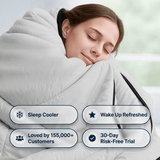



Electric vs Fabric Cooling Blankets: Which Actually Works?
Summer sleep is its own particular misery. You've got the fan going, the window cracked, one leg out from under the covers, and you're still lying there at midnight doing math on how many hours you've got left.
Air conditioning helps. It also costs a fortune and cools your entire house so one person can sleep.
Electric cooling blankets exist, and they work. They also run several hundred dollars, need an outlet, put a unit on your nightstand, and eventually fail the way anything with a circuit board does.
Fabric cooling blankets solve the same problem differently — not by pumping cold air at you, but by conducting heat away from your skin on contact. No power, no maintenance, nothing to break.
Most people asking about electric cooling blankets don't actually need one. Here's how the two compare, so you can work out which camp you're in.
Understanding Electric Cooling Blankets
An electric cooling blanket is bedding with a powered cooling system built in. That's the short version.
The important distinction: a regular electric blanket makes heat. This does the opposite.
It's also worth separating three things people lump together as "cooling":
- Breathable fabric simply doesn't trap heat. Cotton, linen, bamboo. Passive, and it helps, but it isn't actively doing anything.
- Contact-cooling fabric conducts heat off your skin on contact. Usually a nylon or nylon-spandex knit. No power needed, and it's where most of the practical benefit sits for the money.
- Powered systems actively move heat away using electricity, with a pump or a semiconductor.
Three different mechanisms. The last one costs the most and the middle one covers most people's actual problem.
1. How They Work
Four main approaches to powered cooling, and they're not equally common.
Thermoelectric Cooling: Most use the Peltier effect. Run current through a semiconductor junction and one side gets cold while the other dumps heat. No moving parts. That's why they're quiet.
Circulating Water Systems: Thin tubes run through the blanket and a small unit pushes chilled water around them. Effective, but there's a box on your nightstand.
Phase Change Materials (PCMs): Materials that soak up heat as they shift state, then release it later. Usually a supporting player rather than the main system.
Evaporative Cooling: Moisture-wicking fabric that helps sweat evaporate. Honestly this one's barely "electric," but it turns up in hybrid designs.
Benefits of Electric Cooling Blankets
- Better sleep conditions - a cooler surface can make falling asleep easier
- Lower energy use - running one blanket beats cooling a whole house
- Personalized comfort - huge if you and your partner disagree on temperature
- Dual-function models - some heat as well, so they earn their storage space year-round
- A drier bed - less sweat means fewer 3 AM sheet changes
- Fewer dust mites - mites prefer warm and humid, so a cooler bed is less hospitable
Fair enough on the last one, but manage expectations. It's a side effect, not a solution.
Choosing the Right Electric Cooling Blanket
Six things to check before you spend anything.
Size & Coverage: Twin through California king. Measure your bed, not your hopes.
Temperature Control: Adjustable settings at minimum. Digital display, remote, or app control if you want the good version.
Material & Comfort: Cotton, bamboo, microfiber, or Tencel. You're sleeping on this thing, so the fabric matters as much as the tech.
Safety Features: Non-negotiable. Look for recognized safety certification, auto shut-off, overheat protection, and low-voltage design.
Noise Level: Thermoelectric runs near silent. Water systems have a pump. Light sleepers, take note.
Durability & Warranty: A real warranty tells you what the manufacturer actually believes about their product.
Using Your Electric Cooling Blanket Effectively
Pre-cool Your Bed: Switch it on 15 to 30 minutes before you turn in.
Layer Appropriately: Thin sheet between you and the blanket. Protects it, feels better.
Maintain Proper Care: Follow the manual. Every model differs.
Combine with Other Cooling Methods: A fan moving air across the blanket does more than either alone.
Adjust Throughout the Night: Your body temp shifts overnight. Programmable settings handle it while you sleep.
Stay Hydrated: Here's the thing, when you're not sweating you don't feel thirsty. Doesn't mean you aren't.
Potential Drawbacks and Considerations
- Upfront cost - the decent ones aren't cheap
- Needs power - no outlet, no cooling, and there goes camping
- Maintenance - cleaning matters, and water systems need more of it
- Not for everyone — some people just don't like the sensation
- Overcooling - rare, but you can absolutely wake up too cold
- It's electronics now - things with circuits eventually fail
Environmental Impact and Energy Efficiency
- Less energy overall - cooling one bed beats cooling 2,000 square feet
- Targeted cooling - no energy wasted on empty rooms
- Material choices - some makers use recycled or sustainable fabrics, though verify rather than assume
- Less AC runtime - easier on the HVAC system and your bills
- E-waste - the honest counterpoint, since a blanket with a circuit board doesn't compost
Innovations in Cooling Blanket Technology
The category's moving fast.
- Smart controls - sleep tracking and adaptive temperature, so it adjusts without you
- Better materials - more efficient cooling fabrics
- Dual-purpose - cooling and heating in one
- Zone control - your side cold, their side less cold, marriage preserved
- Battery models - portable options for travel or outdoors
Health Considerations and Special Use Cases
Worth a careful word here.
Some people look at these for night sweats or hot flashes during menopause. A cooler, drier bed may make those episodes less disruptive, but no blanket addresses what's causing them. That's a conversation with your doctor. Worth knowing that a contact-cooling fabric blanket covers the same comfort problem without the cost or the power, which is where most menopause sleepers land.
Athletes sometimes use them after training. Some people with fevers find a cooler surface more comfortable, though that's strictly under medical supervision. And there are pet versions, which is a genuinely nice idea for a dog in August.
If you have circulation issues or trouble sensing temperature, talk to your physician before using one.
Comparing Cooling Solutions Side by Side
| Feature | Electric Blanket | Fabric Cooling Blanket | Central AC | Ceiling Fan |
|---|---|---|---|---|
| Targeted cooling | Localized | Localized | Whole space | Wind-chill only |
| Energy efficiency | Efficient | No power needed | Energy-heavy | Very efficient |
| Temperature control | Active, adjustable | Passive, constant | Whole-room | None, air only |
| Initial cost | High | Low | High | Low to moderate |
| Long-term cost | Running cost + replacement | None | Higher running cost | Very low |
| Portability | Needs an outlet | Fully portable | Fixed | Fixed |
| Noise | Silent to minimal | Silent | Noticeable | Varies |
| Maintenance | Cleaning, servicing | Machine wash | Professional servicing | Occasional dusting |
| Failure points | Electronics, pump | None | Compressor, ducts | Motor |
| Environmental impact | Lower than AC, but e-waste | Lowest of the powered options | Highest | Lowest |
The pattern's clear enough. Electric gives you adjustability and costs you money, maintenance, and something that eventually breaks. Fabric gives you none of the controls and none of the failure points.
Tips for Maximizing Your Cooling Blanket's Effectiveness
Blackout curtains. Sunlight heats the room all afternoon before you ever get in bed.
Lightweight sheets. Heavy bedding on top undoes the work underneath.
Time it right. Cold bed beats cooling bed.
Experiment. Nobody nails the setting on night one.
Mind your position. Side, back, and stomach sleepers each contact the surface differently.
Clean it regularly. Efficiency drops when it's grubby.
Store it properly. Cool, dry, not crushed under the Christmas decorations.
Conclusion
Electric cooling blankets are real, they work, and for a specific person they're the right call: someone who wants a dial to turn, who sleeps with a partner on a completely different thermostat, or who needs the heating function in winter too.
For everyone else, that's a lot of money and a lot of hardware for a problem that fabric already solves. A contact-cooling fabric blanket pulls heat off your skin the moment you get under it, costs a fraction as much, goes in the washing machine, and has nothing in it that can fail.
If you want adjustable zones and app control, buy electric. If you just want to stop waking up hot, you don't need a power cord to fix that.
Have a browse through our blankets, cooling pillows, and sheets collections if you want to see what's out there.