

Why 27 Degrees? The Science Behind the Intimacy Pillow Angle
Search this and you'll find pages claiming researchers identified 27 degrees as the perfect angle, sometimes with a named expert attached.
Worth saying plainly: that research doesn't exist. Nobody has run a study establishing an optimal angle for intimacy positioning, and any page telling you otherwise made it up.
What's real is the physics. Elevation changes where weight goes, and where weight goes decides whether a position is comfortable for two minutes or twenty. That part is worth understanding, because it's what actually determines whether a wedge helps you.
So where does 27 degrees come from?

It's a manufacturing specification. Someone designed a wedge, that's the slope it came out at, and the number got printed on the box.
That isn't a criticism. It's a sensible spot in a sensible range, and specifying an angle at all is better than the vague "ergonomic contour" you get from most cushions.
But it isn't a discovered constant. If a competitor sells 25 degrees or 30, they haven't missed anything. The useful window is broad, roughly 20 to 30 degrees for most bodies, and within it the differences are small compared to how firm the wedge is and where you put it.
Treat the number as a spec, the same way you'd read a mattress firmness rating. Useful for comparing. Not a law of nature.
What elevation actually does

Here's the part that holds up.
Lying flat, the pelvis sits in a neutral position. Change that position and someone has to hold it there, usually with the lower back, hips and thighs. That's muscular work, and muscular work is why positions that felt fine at the start get uncomfortable by minute ten.
A wedge does that job instead. Slide it under the hips and the pelvis tilts because the cushion is holding it, not because anyone is bracing. The load travels through foam rather than through knees, hips and lower back.
What people notice is rarely dramatic. It's the absence of fidgeting. Fewer resets, less shifting around, and a position that lasts as long as you want rather than as long as your thighs hold out.
That's the whole mechanism. No blood flow claims, no nerve stimulation theory. Just weight going somewhere other than your joints.
Why steeper isn't better
The obvious next thought is that if some tilt helps, more must help more. It doesn't, and this is where cheap wedges get it wrong.
Push past roughly 30 degrees and a few things start working against you:
Sustainability drops. A steeper angle takes more effort to stay settled on, which reintroduces exactly the muscular work the wedge was meant to remove.
Pressure concentrates. Steeper slopes put more load through a smaller contact area, usually the lower back.
Breathing gets awkward for the person on it, particularly on a firm surface at a sharp angle.
Slipping increases. More slope means more tendency to slide down it, which is why base grip matters more on steep wedges.
Some generic wedges sold for other purposes sit at 30 to 45 degrees, which is why people who improvise with a bed wedge often find it uncomfortable. It isn't wrong for what it was built for. It's just built for something else.
Firmness matters more than the number
Here's what I'd actually check first if I were buying.
A 27 degree wedge that compresses to 15 degrees under load isn't a 27 degree wedge. It's a soft cushion with an optimistic label. Angle is only meaningful if the foam holds it while someone's weight is on it, which is exactly what stacked bed pillows fail at.
Density is what determines that, and it's rarely on the box. The practical test is at home: set it up, put weight on it, and see whether the shape is still there after a few minutes.
Two other things that matter more than a couple of degrees either way:
Base grip. A wedge that migrates across the sheets is a wedge you'll stop using.
Weight rating. Often buried in the spec, and it decides whether the angle holds for you specifically.
What angle is right for you

Depends on your body, which is the honest answer nobody selling a number wants to give.
Height differences between partners, hip flexibility, back sensitivity and body weight all shift what feels sustainable. A gentler lift suits most people starting out, and it leaves room to add height with a folded blanket if you want more.
Start at the lower end. It's much easier to add elevation than to discover mid-session that you've got too much of it.
Where our pillow sits
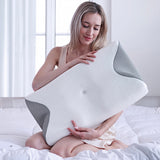
The intimacy pillow is a memory foam wedge at 27 degrees, 22.8 inches long and 9.1 inches at its highest point, with a washable removable cover and plain unmarked shipping.
It's in the range that makes sense, and the memory foam holds shape rather than compressing, which is the property that matters more than the spec. Worth checking the listed weight capacity against your situation before ordering, since that's the limit that decides whether the angle holds.
The number isn't the point
Back to those pages claiming scientists cracked the code.
What's true is simpler and more useful: elevating the hips shifts weight off the joints that were holding a position, and a firm wedge in the low-to-mid twenties range does that reliably. 27 degrees is a reasonable spec inside a reasonable range, not a magic figure. Buy for firmness, grip and a return window, and let the number be the least interesting thing about it.
This information is general and not medical advice. If positioning causes pain, or you're managing a back, hip or pelvic condition, speak to your doctor or physical therapist.